
Decode Franklin County Property Tax Records
Two offices tell the tax story. The assessor publishes values and exemptions while the Tax Commissioner publishes bills and payments, so keep valuation date, digest year, bill year, and any appeal event separate when comparing records.
| Field | What it shows | Official keeper |
|---|---|---|
| Fair market value | Assessor's estimate as of January 1 | Board of Tax Assessors |
| Assessed value | Georgia's 40% taxable assessment base before applicable exemptions | Board of Tax Assessors |
| Exemptions/classification | Homestead, age-based, conservation-use, or Freeport treatment | Board of Tax Assessors |
| Bill and pay status | Tax-year charge and collection status | Tax Commissioner |
| Map/bill number | Account keys used to retrieve a bill | Tax Commissioner |
Sale price is a different number entirely. It comes from transfer records and market activity rather than the tax calculation, so a tax bill alone cannot establish present title or fair sale value.
Search Franklin Tax Year and Payment Status
The official Tax Commissioner portal gives you five controls. Pick a tax year and pay status, choose Owner Name, Bill Number, or Map Number, type your term, and run the search. Owner search takes a full name.
| Portal field | Choice or format | Research purpose |
|---|---|---|
| Tax Year | Available year | Separates billing periods |
| Pay Status | Displayed status option | Narrows current collection state |
| Search Type | Owner, bill, or map number | Selects identifier |
| Search Term | Name or exact number | Finds matching accounts |
| Search | Submit control | Returns the result list |
The captured bill-search screen appears below.
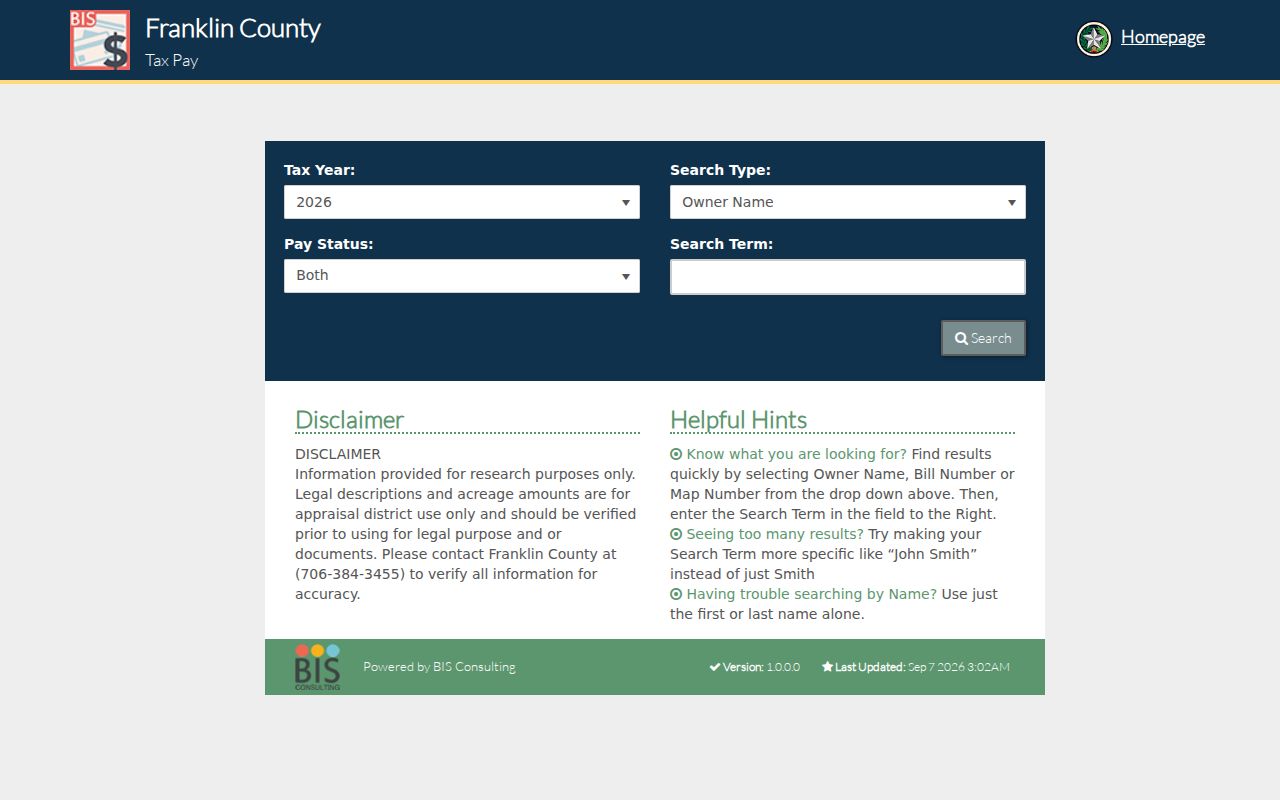
The portal carries a few cautions. It is meant for research only, acreage and legal descriptions serve appraisal use, and the county asks users to verify details by calling 706-384-3455.
Look Up a Franklin County Tax Bill
Use the map number when you have it. Common owner names return too many matches. If you only know an address, start at the qPublic assessor landing page, copy the parcel key, then carry it to the tax portal.
- Identify the correct parcel and preserve its map-number punctuation.
- Select the relevant Tax Year and Search Type in the Tax Commissioner portal.
- Open the bill and record bill number, status, and displayed balance information.
- Compare exemptions and value on the assessor record.
- For delinquency, inspect tax-sale notices and the Clerk's lien/release recordings rather than drawing a title conclusion from the bill alone.
- Assessed value
- The 40% assessment base used in Georgia's tax framework.
- Mill
- One dollar per $1,000 of assessed value, or .001.
- Homestead exemption
- Qualified owner-occupant relief that reduces taxable treatment.
- Tax lien
- A claim arising from unpaid tax that must be researched with recordings and status documents.
Note: Paying a tax bill in Franklin County does not by itself release a recorded lien or clear the title on the parcel.
Franklin Values Begin on January 1
Franklin values lock in on January 1. The Board of Tax Assessors sets value that day. Its January 1 work covers taxability and equalization too, and qPublic pegs assessed value at 40% of fair market value. Online figures show the most current published digest. Timing explains the lag. A new sale, finished improvement, pending appeal, or newly recorded deed may not appear everywhere at once. Field appraisers may visit for an appeal, a return, a new improvement, or a conservation-use review, and you should confirm their identity through the official Tax Assessor office rather than an unsolicited contact.
Franklin Homestead and Age Exemptions
Franklin's exemption menu is long. The standard homestead exemption runs $2,000. Beyond that, the assessor describes age-65 county and school amounts, an age-62 school form, disability and surviving-spouse routes, agricultural current-use treatment, conservation-use covenants, and Freeport inventory relief. Each program sets its own rules. An exemption flag is not proof of ownership, so confirm documents and deadlines in the Franklin County exemption guidance before you rely on one.
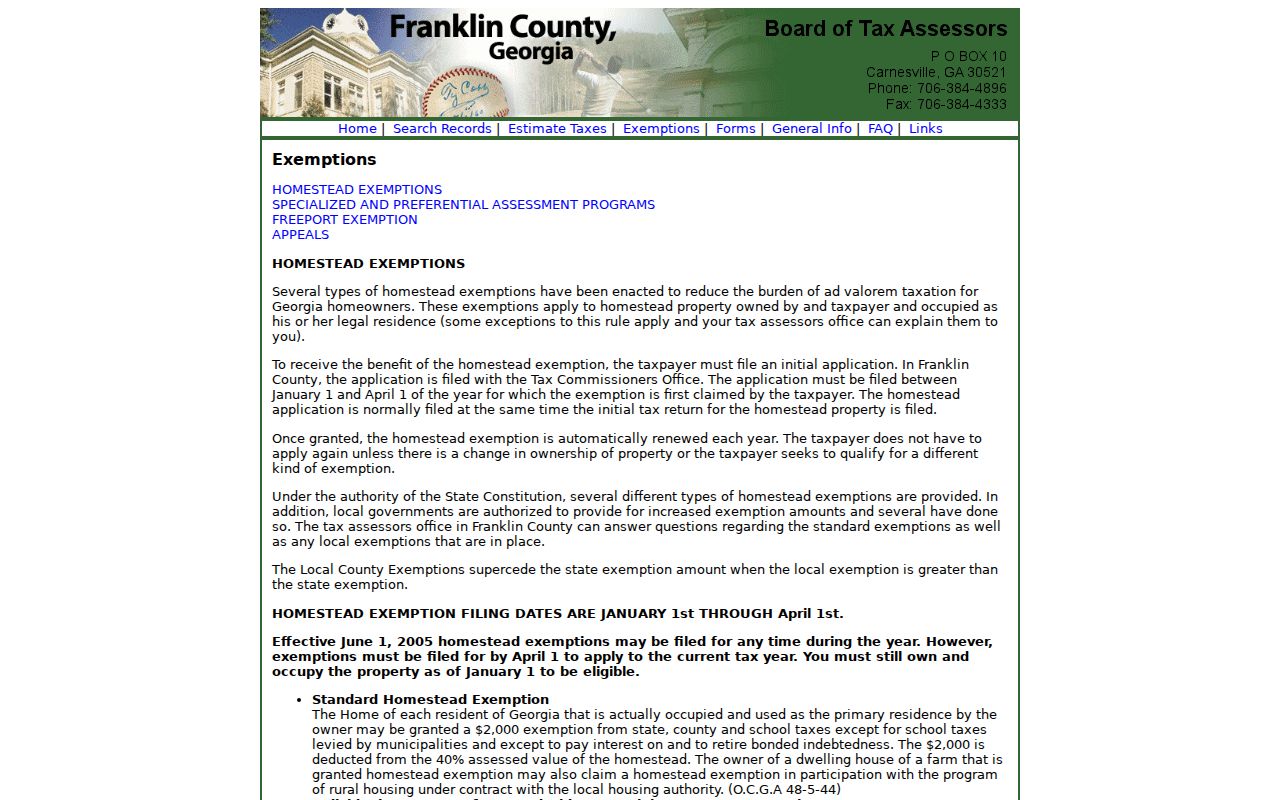
File with the assessor. Confirm the current form and deadline first. Most forms list April 1, but the age-62 school form says June 1, and since the official sources conflict you should never swap one date for the other.
From Mills to the Franklin Tax Bill
Start with assessed value. Subtract any exemptions that apply. Then apply the millage rate. One mill equals $1 for every $1,000 of assessed value, so the arithmetic looks simple. The real bill can layer in multiple taxing authorities and statutory treatment, so treat any do-it-yourself figure as an estimate and compare it with the issued bill.
For payments, forms, collections, and tax-sale details, the Franklin County Tax Commissioner site is the right stop. Payment method and charges follow current portal terms.
Research Delinquency and Tax Sales Across Offices
A delinquent account is only a starting point: note the tax year, owner, map and bill numbers, amount or status, and every notice detail. Then move to the Clerk. The real-estate and lien indexes can hold recorded tax liens, releases, cancellations, sheriff-related instruments, and later conveyances. A tax-sale notice may carry redemption language and deadlines that call for current official or professional guidance.
The split is simple. The Tax Commissioner bills and administers tax sales. The Clerk records the liens and deeds. When no direct list is posted, call the Tax Commissioner or make a precise Franklin County Open Records request, naming the parcel, tax years, document type, and format you want.
Use the 2026 Assessment Trail Carefully
Franklin County has posted 2026 assessment notices. With Board of Equalization activity also underway, "current value" is now a date-sensitive number. Keep a paper trail: save the notice date, digest year, any appeal filing, hearing or board action, and any later corrected value, since a later portal screen can differ from the figure first appealed.
The Board of Tax Assessors receives and reviews appeals. It notifies taxpayers whenever a value changes. Evidence matters. The notice, parcel card, photographs, measurements, comparable sales, appraisal material, permits, and a corrected property description all help, but keep market-value evidence separate from disputes over classification or exemption eligibility.
Contest a Franklin County Assessment
Read the deadline printed on your annual notice. Confirm the filing route with the Board of Tax Assessors at 706-384-4896. No single calendar date covers every appeal. The conflicting exemption-form dates do not apply to valuation appeals, so file within the notice-specific window and keep proof of delivery.
- Save the assessment notice and parcel record as viewed.
- Identify the challenged field: value, uniformity, taxability, classification, or exemption.
- Gather parcel-specific evidence and state the requested correction.
- Submit through the current assessor channel by the notice deadline.
- Track any Board of Equalization record and later digest update.
Appeal window. Use the deadline printed on the Franklin County assessment notice and verify it with the assessor; missing that notice-specific period can end the current appeal opportunity.