
Compare Franklin Property Value Types
Franklin qPublic states that fair market value is set as of January 1 each year and assessed value is 40 percent of fair market value. A deed sale price belongs to a transaction, not the annual assessment. The taxable result can reflect exemptions.
| Value | What It Is | Where |
|---|---|---|
| Fair market value | County estimate at the annual date | Assessor and qPublic |
| Assessed value | Forty percent of fair market value | Assessment record |
| Taxable value | Assessment after qualifying treatment | Assessment and tax records |
| Last sale price | Amount tied to a past transfer | Recorded deed or displayed sale history |
Keep the assessment ratio separate from the millage rate. One mill equals one dollar of tax per $1,000 of assessed value, but those bill mechanics live in the tax records. The value question ends at what each number means.
Fix Franklin's January Value Date
The assessor determines taxability, value, and equalization as of January 1. A later sale or improvement does not make every screen change at once. Record the valuation date and digest year.
qPublic says values reflect the current published digest. Assessment notices mailed July 2, 2026 and a September Board meeting are dated events, not permanent deadlines.
Apply Franklin's Forty Percent Rule
Under the stated framework, assessed value is 40 percent of the fair market figure. That arithmetic will not predict a sale price. Homestead, age, disability, conservation-use, or Freeport treatment may all move the taxable value.
- Fair market value
- The county's full estimate at its stated date.
- Assessed value
- The statutory fraction used for tax work.
- Assessment ratio
- The percentage connecting those figures.
- Sale consideration
- The amount tied to a specific deed.
Estimate Franklin Value From Records
The official qPublic page links Franklin's property search. Judge land, improvement, market, assessed, exemption, or sale fields only on a fully opened parcel card.
- Search the situs address and preserve the parcel key.
- Read only the value fields actually labeled on the card.
- Note the tax year, exemptions, and source date.
- Check the newest deed for prior sale facts.
- Taxable value
- The figure after qualifying treatment.
- Digest
- The county's published roll for a tax cycle.
- Mass appraisal
- A uniform process applied to many parcels.
Separate Franklin Sale Price
A last sale price is history. Match the deed's legal description before weighing it against an assessment. The GSCCCA book/page search shows the recorded deed records behind that figure.
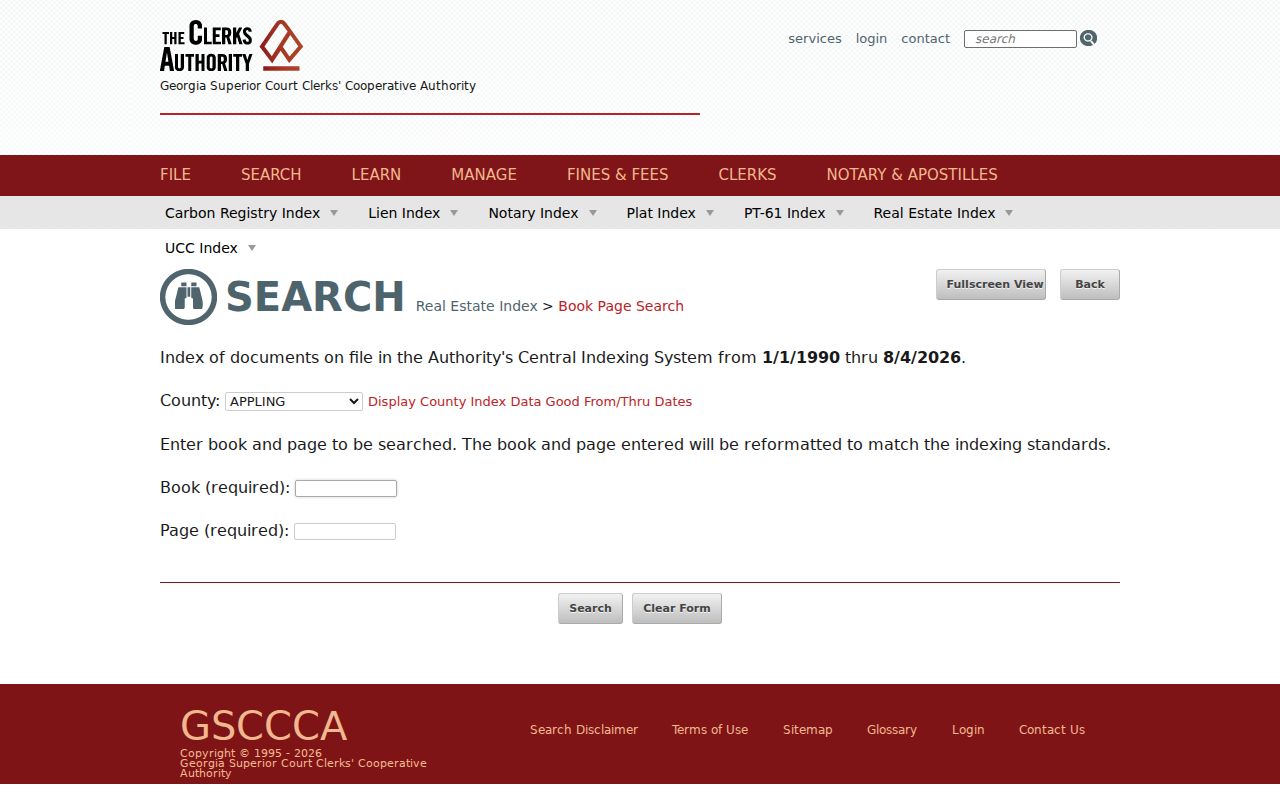
The screen retrieves a known instrument; it is not an appraisal.
Read Franklin Exemption Effects
Exemptions can change taxable value while leaving market value alone. Franklin's own forms conflict on one age-school deadline. One form lists April 1. Another lists June 1. Confirm current timing with the assessor. An exemption may offer a dated occupancy clue, but it never sets private market value.
Use Franklin Sales Maps Carefully
The MIPS viewer offers a Sales tool, though the county disclaims its accuracy and currentness. Treat sales geography as context only, and only after a parcel and deed match. Lake Hartwell-area lots, septic tracts, and rural land may not compare well with a nearby point.
Limit Franklin Property Value Claims
The county value exists for assessment and equalization. It is not a purchase offer. It is not an inspection, title report, or private appraisal. A private appraiser weighs condition and a specific effective date. The recorded sale shows what happened before. It never shows what must happen next. For bills, exemptions, and appeals, turn to the Franklin County property tax records.
Value vs price. [1-2 sentences - a Franklin County assessor value is not what a property will sell for; for a sale or loan, get a licensed appraisal.]